
How Does a Rubber and Plastic Sorting Machine Work?
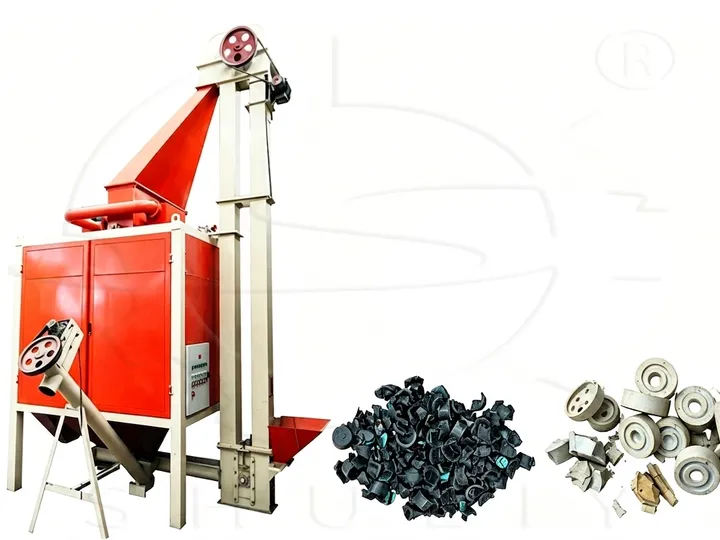
Rubber and plastic sorting machines have become critical equipment in modern recycling facilities, solving one of the industry’s most persistent challenges: separating elastic silicone rubber components from rigid plastic materials. While these materials may appear visually similar after crushing, their fundamentally different physical properties—particularly elasticity, friction coefficients, and rebound characteristics—enable precise mechanical separation.
This technical guide explains the mirror friction and bouncing separation principles behind advanced rubber and plastic sorting machines, detailing how these systems achieve 99%+ purity without chemicals, water, or environmental emissions.
The Challenge: Why Silicone Rubber and Plastic Are Difficult to Separate?
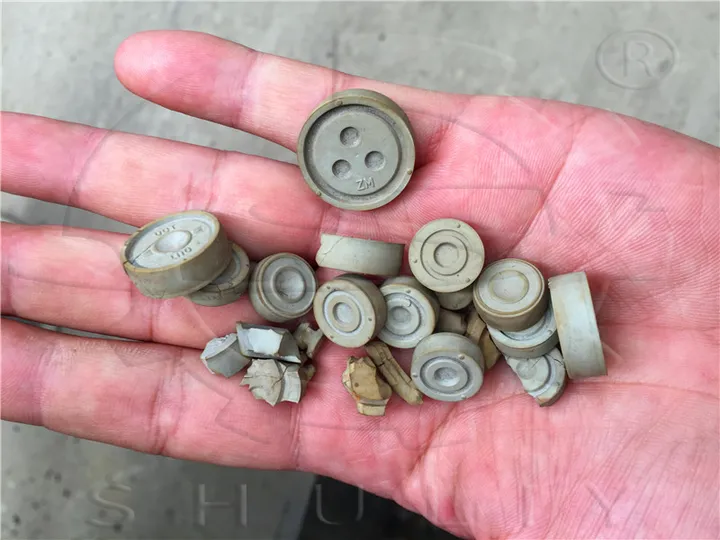
Silicone rubber and engineering plastics like PP, ABS, and PC often coexist in end-of-life products. Medical infusion systems combine PP bottles with silicone seals. Electronic devices integrate ABS housings with rubber gaskets. Appliance manufacturing bonds PC components with elastic buffers.
Traditional separation methods face significant limitations:
Manual Sorting
Workers achieve only 70–85% accuracy while processing 50–100 kg per hour. Fatigue-induced errors contaminate plastic streams with rubber fragments, reducing material value by 20–40%.
Density-Based Methods
Silicone rubber (1.1–1.5 g/cm³) overlaps with many plastics (0.9–1.4 g/cm³), creating density separation inefficiencies.
Optical Sorting
Color and appearance similarities between black rubber seals and dark plastic housings defeat camera-based systems.
The rubber and plastic sorting machine overcomes these limitations through physical property exploitation rather than visual or density characteristics.
Core Separation Principle: Mirror Friction and Bouncing Physics
The rubber and plastic sorting machine operates on an elegantly simple physical principle: materials with different elasticity coefficients and surface friction properties exhibit distinct behaviors when contacting an inclined mirrored surface.
Material Property Differences
| Property | Silicone Rubber | PP Plastic | ABS Plastic | PC Plastic |
|---|---|---|---|---|
| Elastic Modulus (MPa) | 1–10 | 1,300–1,800 | 2,000–2,500 | 2,200–2,400 |
| Rebound Resilience (%) | 50–80 | 5–15 | 15–25 | 20–30 |
| Friction Coefficient | 0.8–1.2 | 0.3–0.5 | 0.4–0.6 | 0.35–0.55 |
| Shore Hardness | 20–80A | 70–80D | 75–85D | 75–85D |
These dramatic property differences—particularly the 3–10× higher rebound resilience of silicone rubber versus plastics—create the separation mechanism.
The Physics of Separation
1. Impact and Compression
Falling material strikes the surface at 1.5–3.0 m/s velocity. Silicone rubber’s low elastic modulus allows significant deformation upon impact, storing elastic potential energy.
2. Energy Storage and Release
Rubber materials compress 20–40% during impact and release stored energy as rebound motion. Plastics experience minimal compression and therefore exhibit much lower rebound velocities.
3. Friction-Driven Trajectory Divergence
Silicone rubber’s higher friction coefficient creates stronger tangential forces during contact. Combined with elastic rebound, rubber fragments achieve launch angles of 35–55°. Plastic fragments exhibit lower friction and lower rebound, producing trajectories of only 10–20°. This divergence enables effective separation.
Machine Structure and Component Design
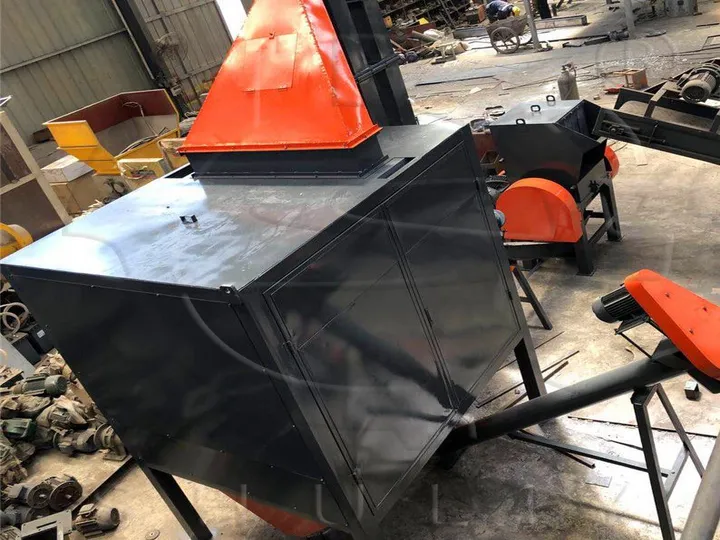
Feeding System
The machine employs a variable-speed vibrating feeder that:
- Disperses material into a monolayer
- Regulates throughput at 600–1,200 kg/hour
- Prevents bridging and ensures consistent flow
Mirror Friction Surface
Surface Specifications
| Article | Specification |
|---|---|
| Material | 304 Stainless Steel |
| Finish | Mirror Polish, Ra 0.05–0.10 μm |
| Dimensions | 2,500 × 1,250 mm or 3,500 × 1,800 mm |
| Inclination | 15–25° Adjustable |
| Chrome Plating | 50–100 μm |
Collection and Separation Zones
Zone 1: Rubber Collection
- Positioned at the upper collection area
- Captures silicone rubber fragments with rebound trajectories of 35–55°
Zone 2: Mixed Fraction Return
- Captures partially separated material
- Automatically returns material for reprocessing
Zone 3: Plastic Collection
- Collects rigid plastic fragments following downward trajectories
- Achieves high collection efficiency
Control System
The machine integrates:
- Siemens S7-1200 PLC controller
- 11-inch touchscreen HMI
- Vibration sensors
- Material level detectors
- Motor current monitoring
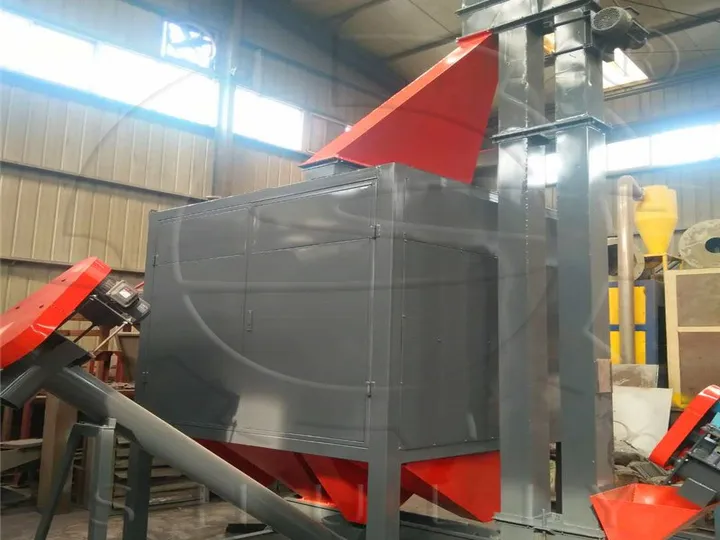
Separation Process: Step-by-Step Analysis
Step 1: Material Preparation and Sizing
Requirements:
- Crushing size: 10–50 mm
- Moisture content: <5%
- Metal contaminants removed
Step 2: Controlled Feeding and Dispersion
The vibrating feeder distributes material evenly across the sorting surface while maintaining optimal layer thickness.
Step 3: Primary Separation on Mirror Surface
The process includes:
- Impact phase
- Contact phase
- Rebound phase
During these stages, rubber and plastic materials exhibit distinctly different trajectories.
Step 4: Airflow Refinement (Optional)
Advanced systems may introduce transverse airflow to further enhance separation purity.
Step 5: Collection and Quality Verification
Output streams include:
- Rubber stream
- Plastic stream
- Return stream
Inline monitoring systems verify purity continuously.
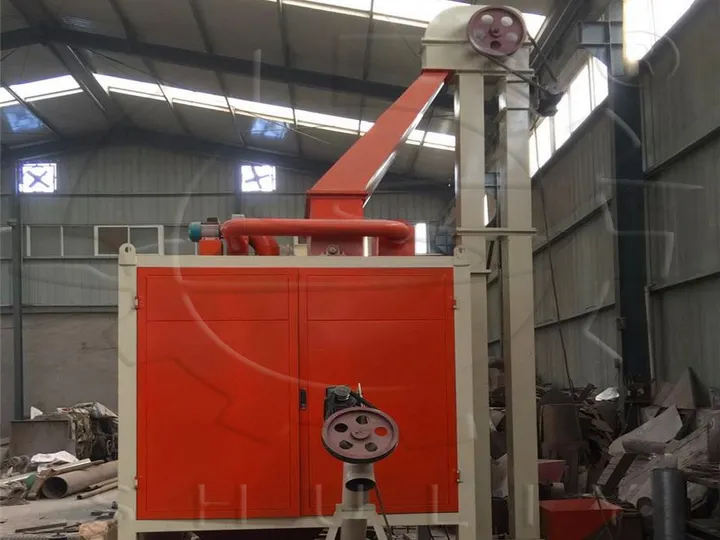
Performance Optimization Factors
Surface Condition Maintenance
| Article | Requirement |
|---|---|
| Cleaning Interval | Every 8–12 hours |
| Cleaning Method | Soft brush + isopropyl alcohol |
| Surface Renewal | Every 2,000–3,000 hours |
Operating Parameter Optimization
| Material Type | Surface Angle | Vibration Frequency | Airflow Speed | Throughput |
|---|---|---|---|---|
| Medical PP/Silicone | 18–20° | 20–22 Hz | 5–6 m/s | 800 kg/h |
| Electronic ABS /Rubber | 20–22° | 22–25 Hz | 6–7 m/s | 900 kg/h |
| Appliance Mixed Plastics | 22–25° | 25–28 Hz | 7–8 m/s | 1,000 kg/h |
| Battery PP /Silicone Plugs | 18–20° | 18–20 Hz | 4–5 m/s | 700 kg/h |
Environmental Conditions
- Temperature: 15–35°C
- Humidity: <60% RH
Comparison with Alternative Separation Technologies
| Technology | Pureté | Throughput | Operating Cost | Environmental Impact | Capital Cost |
|---|---|---|---|---|---|
| Mirror Friction- Bouncing | 99%+ | 600–1,200 kg/h | $8–12/ton | Zero emissions | $45,000–65,000 |
| Manual Sorting | 70–85% | 50–100 kg/h | $25–40/ton | Minimale | $5,000–10,000 |
| Density Flotation | 85–92% | 300–500 kg/h | $15–22/ton | Wastewater generation | $35,000–50,000 |
| Optical Sorting | 90–95% | 400–800 kg/h | $12–18/ton | Energy intensive | $60,000–90,000 |
| Electrostatic Separation | 95–98% | 500–1,000 kg/h | $10–15/ton | Minimale | $50,000–75,000 |
Applications and Industry Implementation
Medical Waste Recycling
Typical implementation:
- SL-1250
- 800 kg/hour
- 99.2% PP purity
Electronic Waste Processing
Typical implementation:
- SL-1800
- 1,000 kg/hour
- 99.1% ABS/PC purity
Automotive Battery Recovery
Typical implementation:
- 98.8% purity
- Battery-grade PP recovery
Conclusion
Le rubber and plastic sorting machine represents a sophisticated application of friction, elasticity, and trajectory mechanics. By exploiting the dramatic physical property differences between silicone rubber and engineering plastics, these systems achieve 99%+ separation purity without water, chemicals, or environmental emissions.
As global demand for high-purity recycled plastics continues to grow, mirror friction-bouncing technology will play an increasingly important role in modern recycling operations and circular economy development.