
How Does a Dry Ice Block Machine Make Dry Ice Blocks?
A dry ice block machine makes dry ice blocks in two physical stages. First, liquid CO2 expands through a nozzle and turns into fine dry ice snow at −78.5°C. Then a hydraulic press compresses that snow into a dense, solid block of 1,450–1,550 kg/m³. No binder, no refrigerant, and no external freezing is involved. The whole cycle runs automatically and repeats every few minutes.
Understanding this process helps you judge block quality, control production cost, and choose the right model. Below is a complete, data-based explanation of how a dry ice block making machine actually works.
What Is a Dry Ice Block Machine?
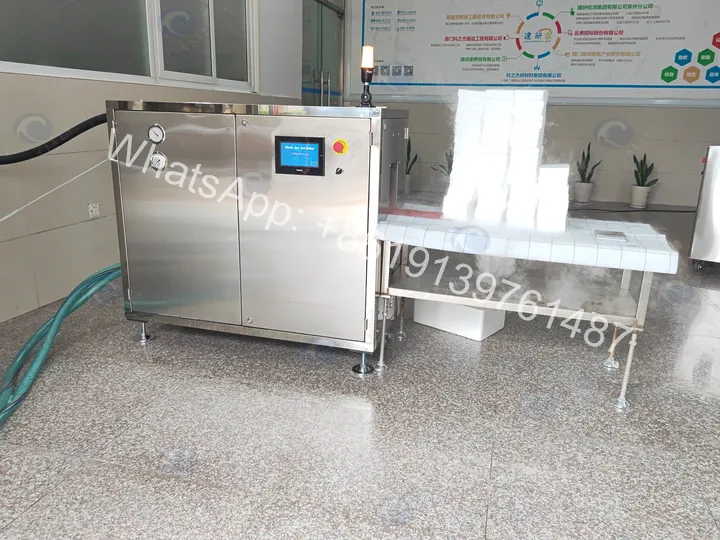
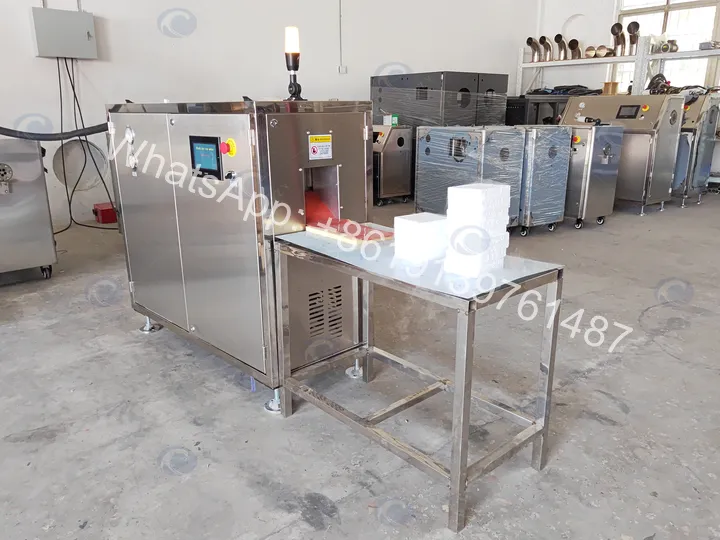
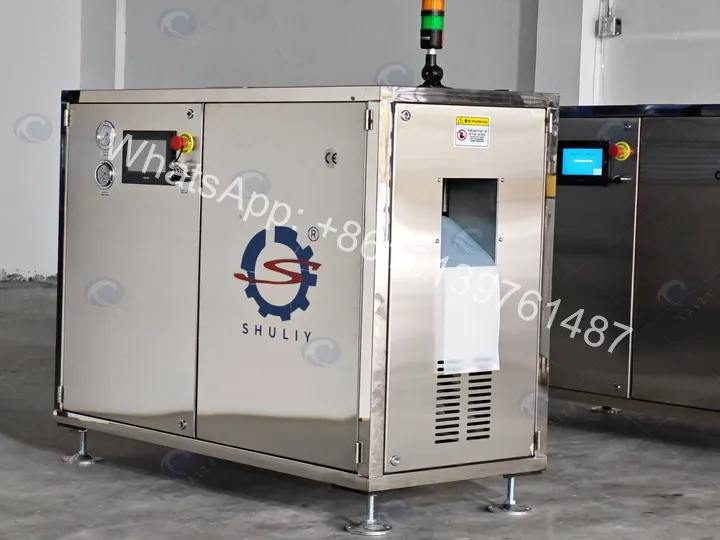
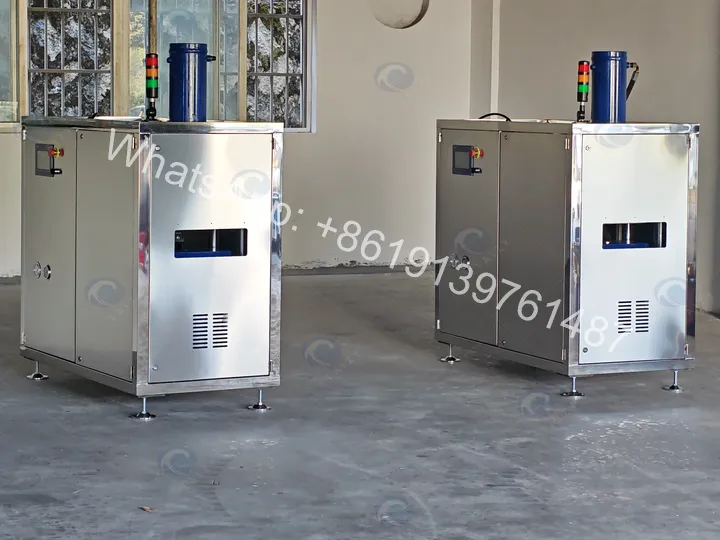
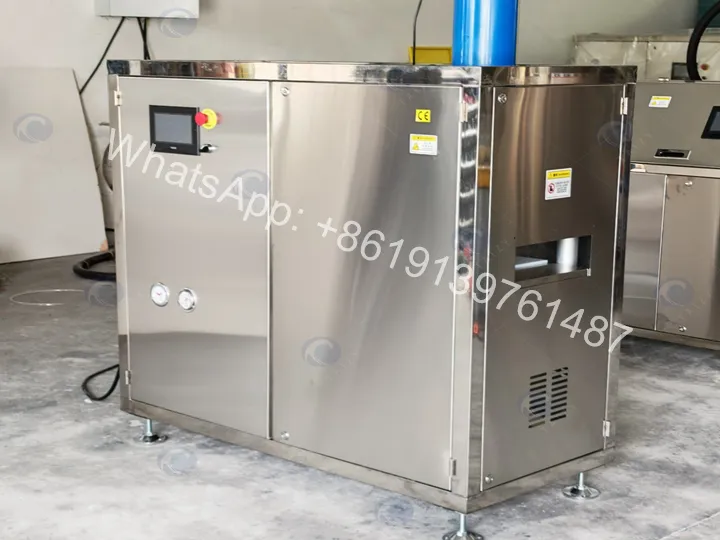
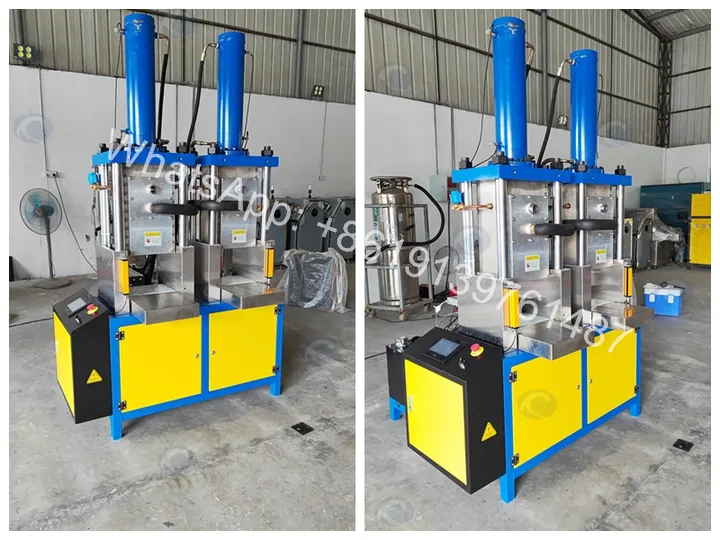
A dry ice block machine is a hydraulic press system that converts liquid carbon dioxide into solid dry ice blocks. It connects directly to a low-temperature liquid CO2 tank. Inside a fully enclosed chamber, the machine performs expansion, snow collection, compression, and demolding in one continuous cycle.
Shuliy offers three models. The SL-120 produces 120–180 kg/h with 4 kW of power. The SL-240 and SL-300 deliver 200–300 kg/h. Block sizes are 125×105 mm or 210×125 mm, with thickness adjustable from 15 to 70 mm.
Why Does Liquid CO2 Turn into Dry Ice Snow at 42% Conversion?
The key to the whole process is the phase behavior of CO2. Liquid CO2 is stored at about −20°C and 2.0–2.2 MPa. Carbon dioxide cannot exist as a liquid at atmospheric pressure. Its triple point sits at 5.1 bar and −56.6°C.
When liquid CO2 passes through the expansion nozzle, pressure drops suddenly to near-atmospheric level. Part of the liquid flashes into gas. This gasification absorbs a large amount of latent heat. The remaining liquid loses heat rapidly and freezes into fine dry ice snow at −78.5°C.
Thermodynamics fixes the ratio. Under standard conditions, only about 42–45% of the liquid mass can become solid snow. The rest becomes cold CO2 gas. This is exactly why Shuliy machines specify a liquid-to-solid conversion ratio of ≥42%. The figure is not a marketing claim. It is the physical ceiling of the expansion process, and precise nozzle and chamber design keeps the machine at that ceiling.
Step-by-Step: How Does a Dry Ice Block Maker Compress Snow into Blocks?
Once snow forms, the second stage begins. The complete working cycle of a dry ice block maker runs as follows:
- Liquid CO2 feeding. Liquid CO2 flows from the storage tank through an insulated inlet line into the sealed forming chamber.
- Expansion and snow formation. The nozzle releases pressure. Snow falls and accumulates evenly in the compression cavity below.
- Hydraulic compression. The press cylinder drives the punch downward. Loose snow at roughly 250–600 kg/m³ is compacted to 1,450–1,550 kg/m³. The particles interlock mechanically under high pressure. No heat or additive is needed.
- Pressure holding. The system holds pressure briefly. This step stabilizes block strength and reduces internal cracks.
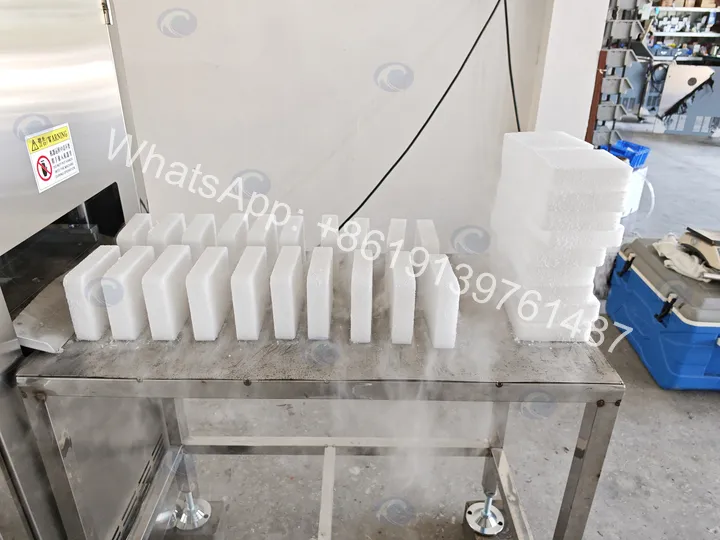
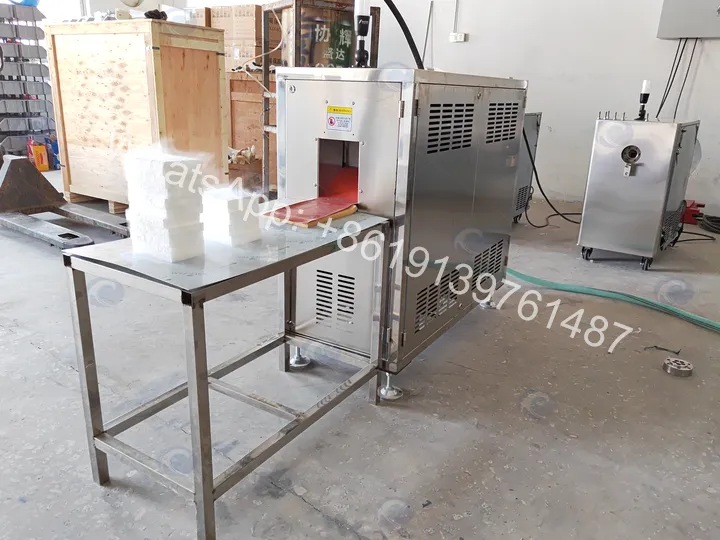
- Demolding and discharge. The mold releases and the finished block is pushed out automatically. The operator never touches the −78.5°C surface.
- Cycle repeat. The punch resets and the next batch of snow forms. Models like the SL-300 complete this cycle fast enough to reach 200–300 kg per hour.
Because the chamber is fully enclosed, the machine starts producing usable blocks immediately. There is no snow spray at startup and almost no material waste between cycles.
Which Parameters Affect Dry Ice Block Quality?
Three parameters control whether a block survives transport and handling.
- Compression density. Density determines sublimation rate and hardness. A block at 1,550 kg/m³ sublimates slower and resists breakage better than one at 1,450 kg/m³. High-precision machining of the press cylinder and mold keeps density stable across every cycle.
- Block thickness. Thickness is set on the control panel between 15 and 70 mm. Thin blocks of 15–20 mm suit short trips and quick cooling. Thick blocks of 50–70 mm serve long-distance cold chain shipping, where slower sublimation matters most.
- Pressure holding time. A short hold after full compression lets internal stress equalize. Blocks come out with fewer micro-cracks and cleaner edges. PLC control keeps this timing identical for every block.
Dry Ice Block vs Pellet: Why the Compression Stage Matters?
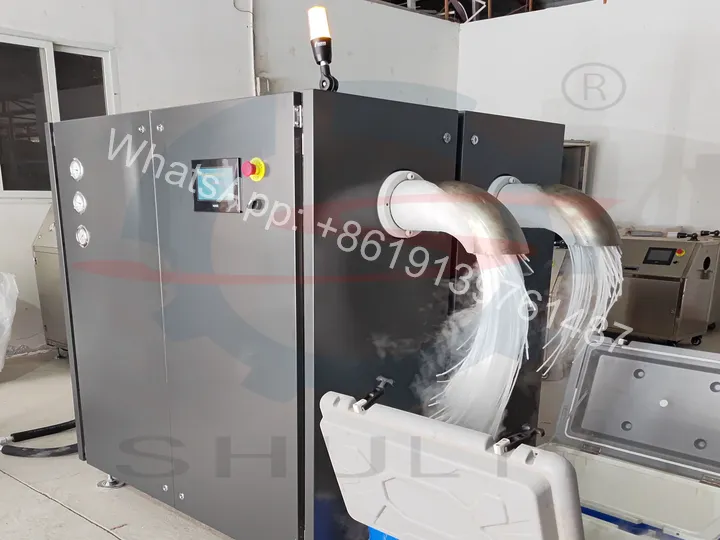
Dry ice pellets are extruded through a die, not pressed in a mold. They cool fast but carry a large surface area relative to their mass. Sublimation loss is high during long storage.
A dry ice block press machine works differently. Mold compression creates a large, low-surface-area body. Blocks lose only about 3–8% of mass per day in insulated storage. This is why blocks dominate long-haul cold chain, airline catering, and remote laboratory supply, while pellets serve blasting and short-term cooling.
How Can You Maintain Stable Dry Ice Block Production?
- Keep tank pressure stable. Maintain liquid CO2 supply at 2.0–2.2 MPa. Pressure drops reduce snow yield below the 42% conversion ratio.
- Use clean, dry CO2. Moisture freezes inside the nozzle and disturbs expansion. Food-grade CO2 with low water content protects both the nozzle and block purity.
- Check seals monthly. Worn seals leak pressure during compression and lower block density. Replace them on schedule.
- Match thickness to the job. Do not default to maximum thickness. Set 15–25 mm for same-day delivery and 50–70 mm for multi-day shipping.
- Insulate storage immediately. Move finished blocks into thick insulated containers within minutes. Minimize empty space inside the box.
Choosing the Right Dry Ice Block Machine for Your Output
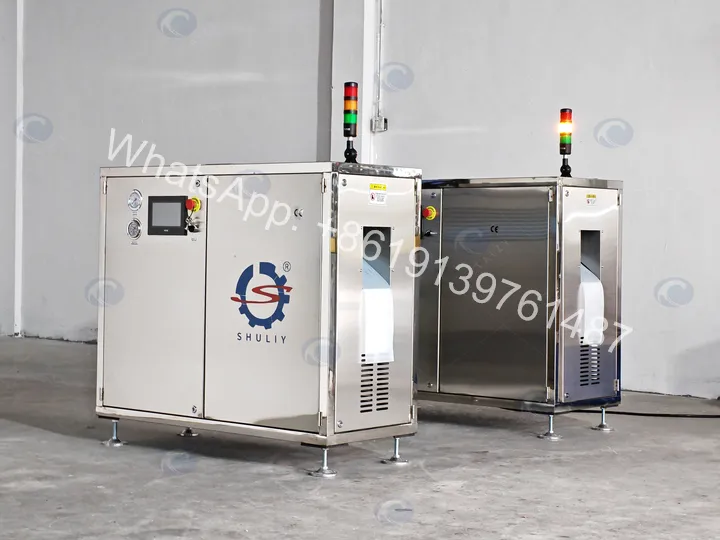
For small cold chain firms and seafood processors, the SL-120 covers 120–180 kg/h in a 1-square-meter footprint. For distribution hubs running daily batches, the SL-240 reaches 200–300 kg/h with an 8 kW drive. For export-oriented suppliers needing larger 210×125 mm blocks, the SL-300 one-step forming dry ice block machine completes the shape in a single press cycle with only 5 kW.
If your business also needs blasting media, pair the block machine with a Dry Ice Pelletizer Machine to cover both markets from one CO2 supply.
Start Your Dry Ice Block Production with Shuliy
Shuliy Machinery has exported CO2 processing equipment to over 50 countries for more than 20 years. Every dry ice block machine is factory-tested and delivered with an English manual and lifetime technical support.
Tell us your daily output target, block size, and local voltage. Our engineers will recommend the right model and send a detailed quotation within 24 hours. Contact Shuliy today.