
Activated Carbon Making Machine | Carbonization Furnace for Activated Carbon Production
| Marca | Máquinas Shuliy |
| Furnace Type | Continuous Rotary Carbonization & Activation Furnace |
| Heating Type | Internal Heat / External Heat |
| Processing Capacity | 1–8 tons/day |
| Operating Temperature | 880–1050°C |
| Pre-Carbonization Temperature | 500–800°C |
| Drum Diameter | 1.5–2.6 m |
| Drum Length | 11–22 m |
| Drum Speed | 1–2 r/min, Adjustable |
| Residence Time | 60–120 min |
| Raw Material Size | ≤30 mm |
| Raw Material Moisture | <15% |
| Activation Medium | Steam / CO₂ / Hydrogen |
| Installed Power | Approx. 40–55 kW for standard internal-heat models |
| Activation Performance | Iodine Value: 600–1500 mg/g |
| Main Raw Materials | Coconut Shell, Fruit Shell, Wood Chips, Sawdust, Bamboo, Rice Husk, Straw |
| Applicable Products | Activated Carbon for Water, Air, Wastewater, Food, Pharmaceutical and Gold Recovery Applications |
Agora você pode pedir detalhes técnicos aos nossos gerentes de projeto
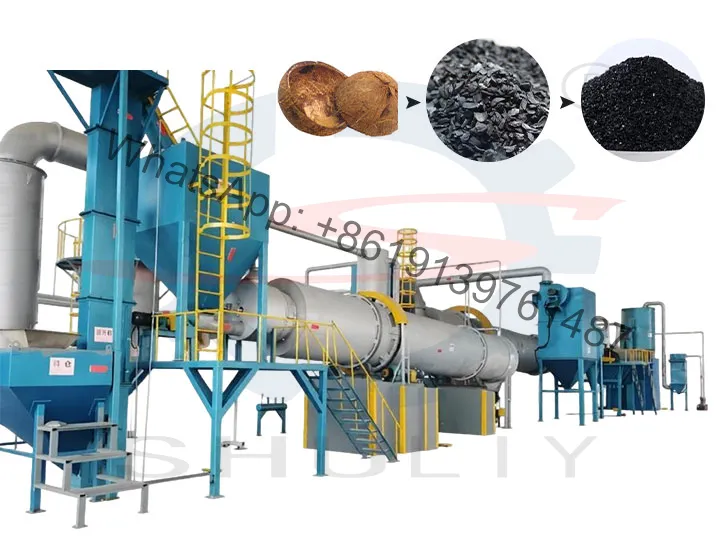
An activated carbon making machine converts carbon-rich raw materials into high-surface-area activated carbon through controlled carbonization and activation. Shuliy systems process coconut shells, wood chips, bamboo, coal, and agricultural waste into premium activated carbon for water purification, air filtration, and industrial applications.
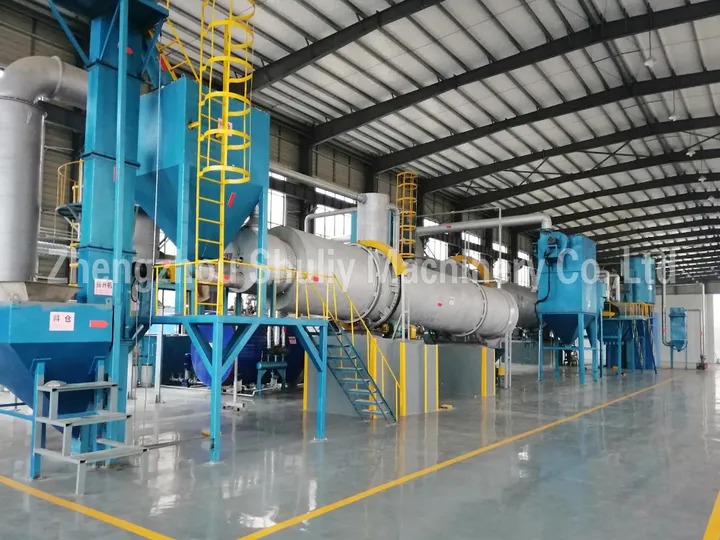
Unlike standard charcoal production, activated carbon production equipment requires precise temperature control and extended residence time to develop the porous structure that defines activated carbon. Our continuous carbonization furnaces operate at 500-900°C with adjustable oxygen levels to optimize pore development and surface area.
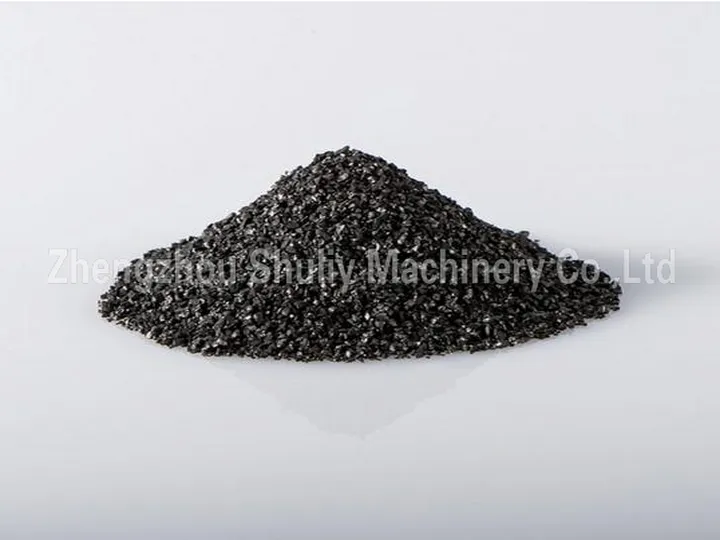
With 20+ years of thermal processing equipment manufacturing and exports to 50+ countries, Shuliy provides complete activated carbon production lines. Our activated carbon manufacturing system helps clients produce coconut shell activated carbon, wood-based activated carbon, and coal-based activated carbon meeting international quality standards.
What Is an Activated Carbon Making Machine?
An activated carbon making machine is specialized thermal processing equipment that converts raw carbonaceous materials into activated carbon through two sequential processes: carbonization and activation. Carbonization removes volatile compounds in an oxygen-limited environment. Activation develops the internal pore structure using steam, carbon dioxide, or chemical agents.
The machine line includes raw material preparation, carbonization furnace, activation unit, cooling system, and collection equipment. Advanced PLC control maintains precise temperature profiles throughout both process stages.
Raw Materials for Activated Carbon Production
Activated carbon production equipment processes diverse feedstocks:
Plant-Based Materials:
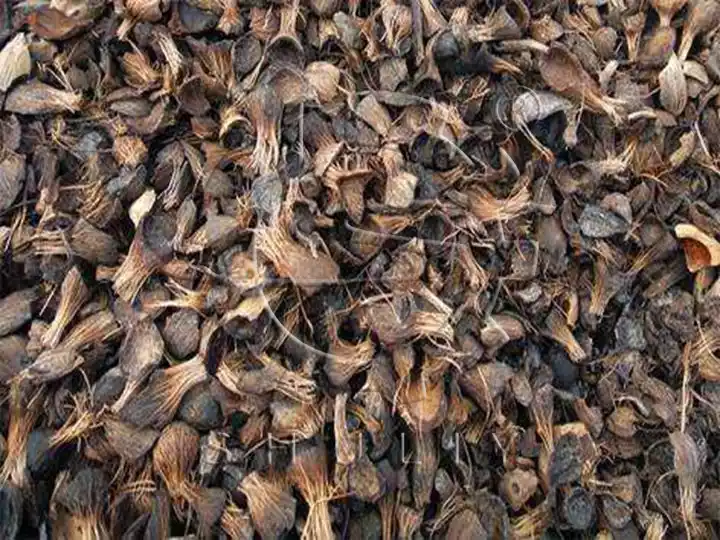
- Coconut shells (highest hardness and surface area)
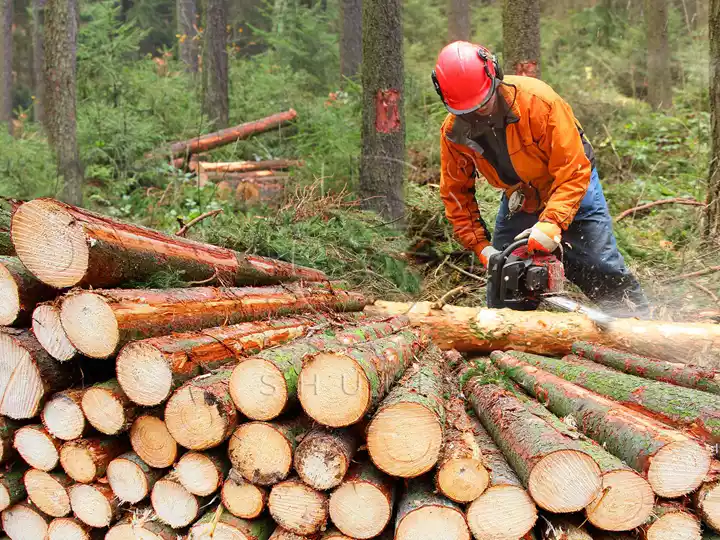
- Wood chips and sawdust
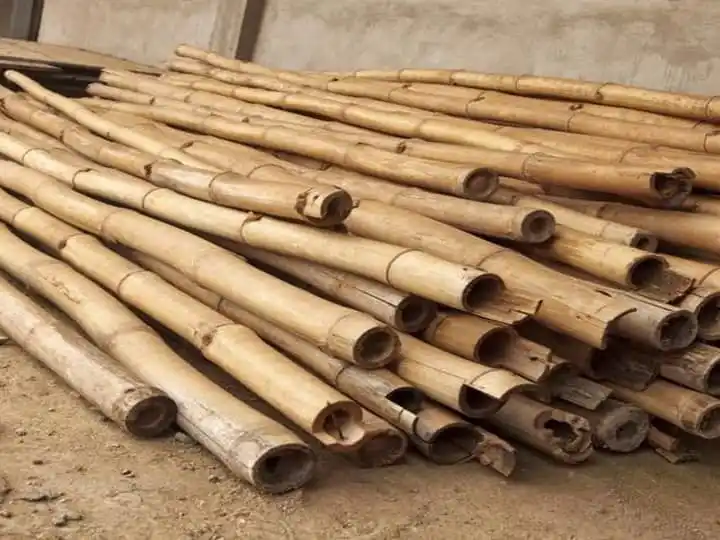
- Bamboo and bamboo waste
- Fruit pits and nut shells
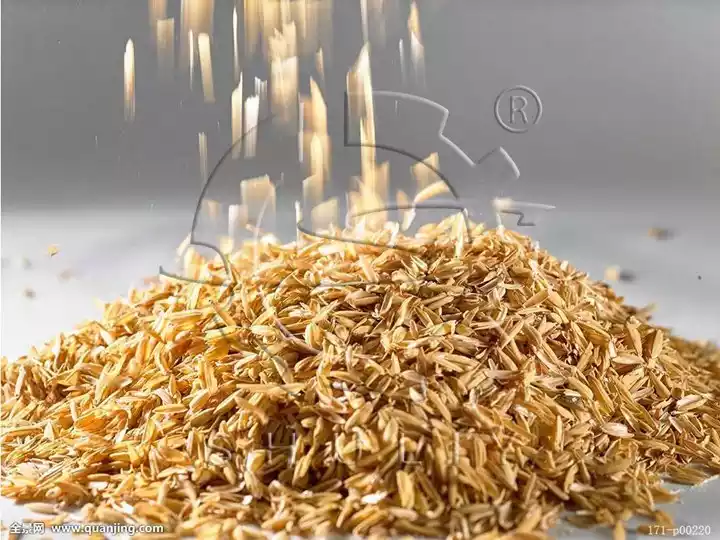
- Agricultural residues (rice husk, straw)
Mineral-Based Materials:
- Bituminous coal and anthracite
- Peat and lignite
- Petroleum coke
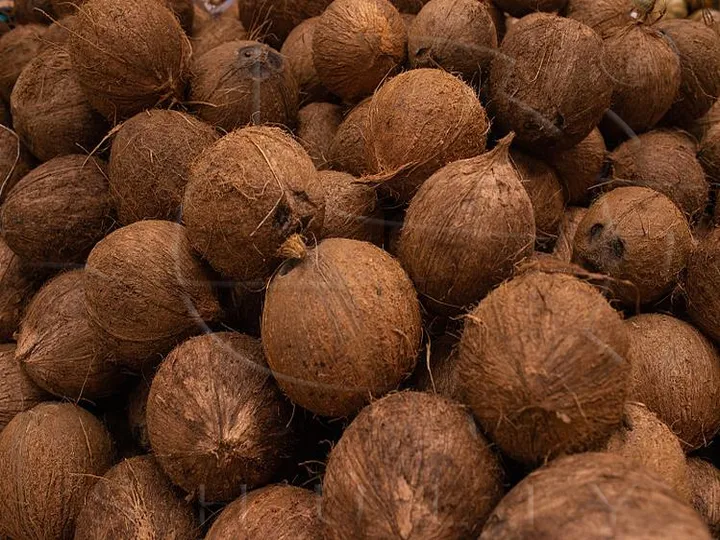
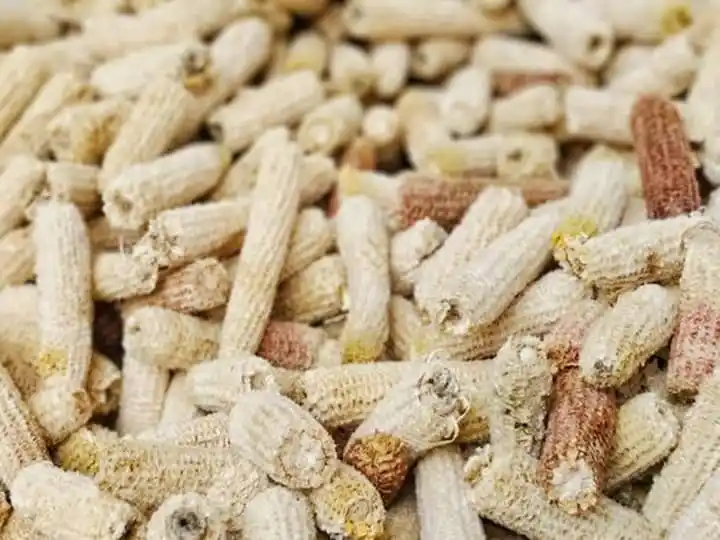
Coconut shell produces the highest quality activated carbon due to natural hardness and low ash content. Wood-based activated carbon suits decolorization applications. Coal-based activated carbon handles gas phase applications.
Activated Carbon Production Process
The activated carbon making machine performs a two-stage thermal process.
Stage 1: Carbonization
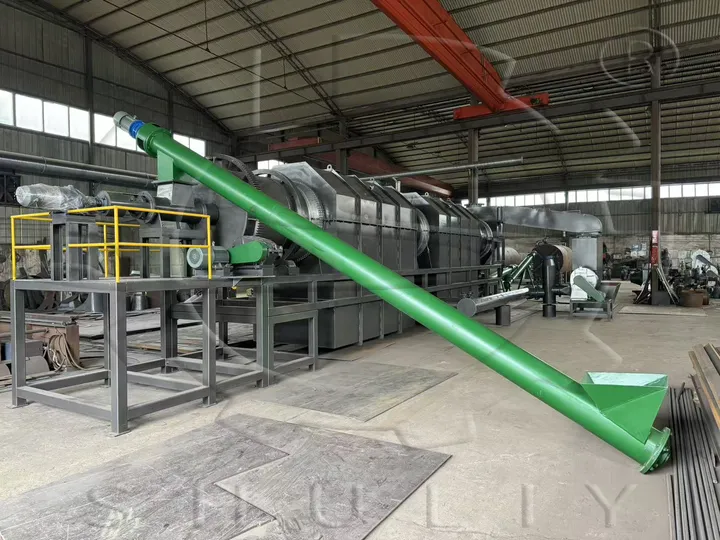
Raw material enters the forno de carbonização contínua at 400-600°C. Oxygen-limited conditions prevent complete combustion. Volatile compounds escape as pyrolysis gas. Fixed carbon remains as char material.
Carbonization reduces material weight by 60-70%. The resulting char has minimal porosity and requires activation to develop adsorption capacity.
Stage 2: Activation
Char material moves to the activation unit. High-temperature steam or carbon dioxide reacts with the carbon surface at 800-1,000°C. This reaction creates millions of microscopic pores.
Activation increases internal surface area from 100 m²/g to 1,000-2,000 m²/g. The porous structure traps contaminants in water and air applications.
Two Main Types of Activated Carbon Making Machines
Activated carbon making machines can generally be divided into internal-heat e external-heat systems. The main difference is how heat is transferred to the raw material and whether the material comes into direct contact with combustion gas.
Internal-Heat Activated Carbon Making Machine
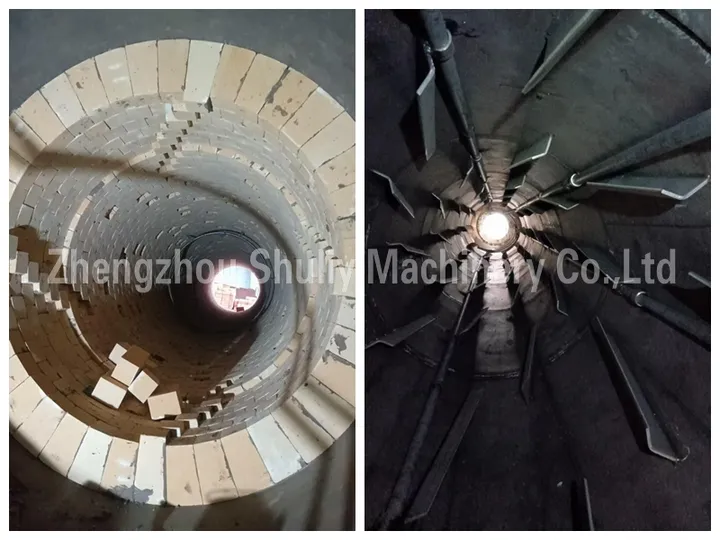
An internal-heat activated carbon making machine uses a direct-heating rotary carbonization system. Hot flue gas enters the rotating drum and comes into direct contact with the raw material. Heat is supplied by fuel combustion and can also be recovered from the combustible gases released during pyrolysis.
Because the combustion gas transfers heat directly to the material, this design provides rapid heat transfer and high thermal efficiency. It is suitable for processing various biomass and carbon-rich feedstocks where efficient heating and continuous operation are important.
However, direct contact between the flue gas and the material requires careful control of combustion and airflow conditions. Improper operation may increase ash contamination or cause partial oxidation and carbon loss.
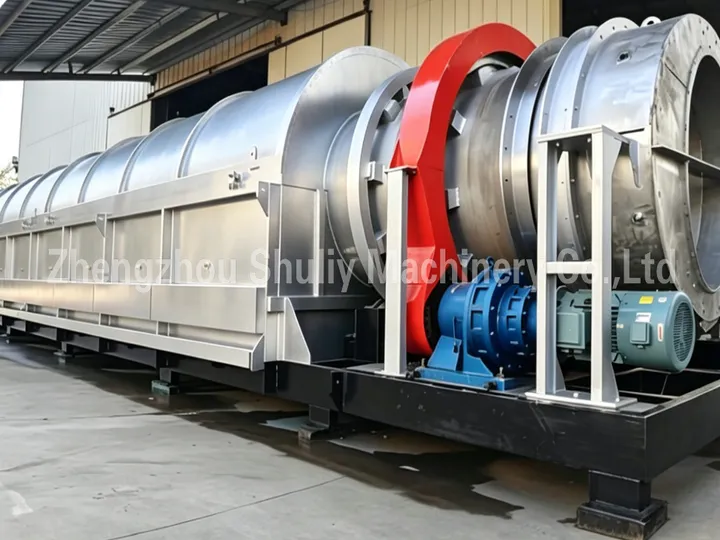
The following table shows standard internal-heat rotary models for activated carbon production:
| Modelo | Capacidade | Carbonization Temp. | Activation Temp. | Poder | Application |
|---|---|---|---|---|---|
| SL-AC 300 | 300-500 kg/h | 400-600°C | 800-950°C | 45 kW | Small production |
| SL-AC 600 | 600-800 kg/h | 400-600°C | 800-950°C | 75 kW | Medium plants |
| SL-AC 1000 | 1,000-1,500 kg/h | 400-600°C | 800-950°C | 120 kW | Large facilities |
| SL-AC 2000 | 2,000-3,000 kg/h | 400-600°C | 800-950°C | 200 kW | Industrial scale |
External-Heat Activated Carbon Making Machine
An external-heat activated carbon making machine uses an indirect heating method. The combustion chamber is installed outside the rotating drum, and hot flue gas heats the drum wall without directly contacting the raw material. This allows the material to be carbonized in a controlled, low-oxygen environment.
During carbonization, volatile gases released from the raw material can be collected and redirected to the combustion chamber as a secondary fuel. After ignition, these gases provide part of the heat required for continuous operation, helping improve fuel utilization.
Since the carbonized material is isolated from the combustion gas, the external-heat design can help reduce ash contamination, minimize unnecessary burn loss, and provide better control over carbonization quality. It is suitable for activated carbon production where consistent carbonization conditions and product quality are important, including applications in water treatment, air purification, and industrial adsorption.
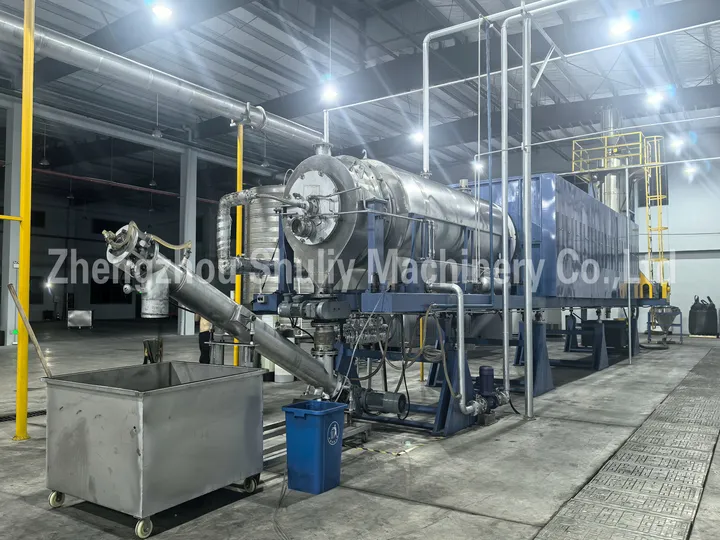
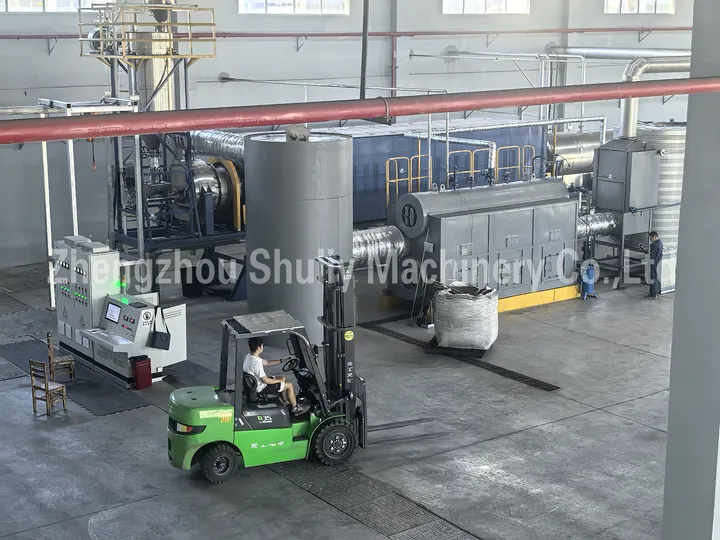
A complete external-heat gasification carbonization furnace for activated carbon includes feeding, carbonization, gas purification, and cooling units. The table below lists the standard configuration for one SLJY-1600 production line:
| Equipment | Specification | Power (kW) | Function |
|---|---|---|---|
| Z-type conveyor | 36/18 × 6m | 2.2 | Feeds raw material into storage bin |
| Storage bin | Φ2m × 5m | 3 | Buffer storage, Q235 steel |
| Screw conveyor | Φ325mm × 6m | 4 | Transports material to forno variable frequency |
| Flat-port feeder | Φ325mm × 2m | 3 | Sealed feeding, prevents air entry |
| Carbonization furnace main drum | JY-1600 | — | Φ1.6m × 12m, 310S stainless steel, 30mm wall, 310S flights 8mm thick |
| External insulation box | 6m × 2.1m × 2.2m | — | Q235 shell, aluminum silicate modules, fish-scale seal |
| Main operation platform | 10m × 1m × 1.5m | — | 100# channel steel, Q235 |
| Drive system | Φ1750 | 18.5 | Large gear, support rollers, variable-speed motor |
| Inlet/outlet end covers | 2.1m × 0.7m × 2.2m | — | Q235 with aluminum silicate lining, 3-layer seal |
| Furnace head platform | 1m × 1.5m × 1.8m | — | Q235 with checkered plate floor, includes ladder |
| Main frame | 12m × 2.2m × 0.8m | — | 160# channel steel, Q235 |
| Main fan | Y5-47 | 15 | 304 stainless steel, water-cooled bearing, variable frequency |
| Cooling discharge screw | Φ325mm × 6m | 4 | Q235 with water jacket |
| Rotary discharge valve | DN400 | 2.2 | Cast iron |
| Gas supply and exhaust system | Custom | — | Steam pipe, converter, valves, exhaust pipe |
| Water supply and return pipes | Custom | — | Galvanized pipes approx. 100m, water level gauge, alarm |
| Waste heat boiler | 0.5T | — | Provides steam for production, national standard |
| Preheater | 1.5m × 1m × 1m | — | Preheats boiler feed water |
| Spray tower | Φ0.8m × 3m | 2.2 | Cools boiler exhaust gas |
| Rotary carbon cooler | Φ1m × 10m | 8.5 | Secondary cooling of activated carbon, variable frequency |
| Cooling tower | 100T | 2.2 | FRP, cools circulating water for carbon cooler |
| Control cabinet | 1.5m × 0.4m × 1m | — | Andeli brand |
Key Advantages of Shuliy Activated Carbon Making Machine
Precise Temperature Control
Multi-zone temperature control maintains optimal carbonization and activation profiles. PLC automation adjusts parameters based on raw material characteristics.
Continuous Operation
24/7 production capability maximizes output. Automated feeding and discharge reduce labor requirements to 1-2 operators per shift.
Flexible Raw Material Processing
Quick-change tooling adapts the line to coconut shells, wood, coal, or mixed feedstocks. No major modifications are needed for material switching.
High Yield and Quality
Optimized residence time ensures complete carbonization. Controlled activation develops a consistent pore structure and surface area.
Energy Efficiency
Combustible gas recycling provides 40-60% of thermal energy. External fuel consumption remains minimal after startup.
Conformidade Ambiental
Sealed furnace design and multi-stage gas treatment prevent emissions. Water-cooled discharge eliminates dust and fire hazards.
Complete Turnkey Solution
Shuliy delivers the entire production line, including crusher, dryer, carbonization furnace, activation unit, and packaging equipment.
Customizable Production Capacity
The activated carbon making machine can be customized according to raw material type, required capacity, activation method, and final product specifications. This allows the production line to match different investment and processing requirements.
Applications of Activated Carbon
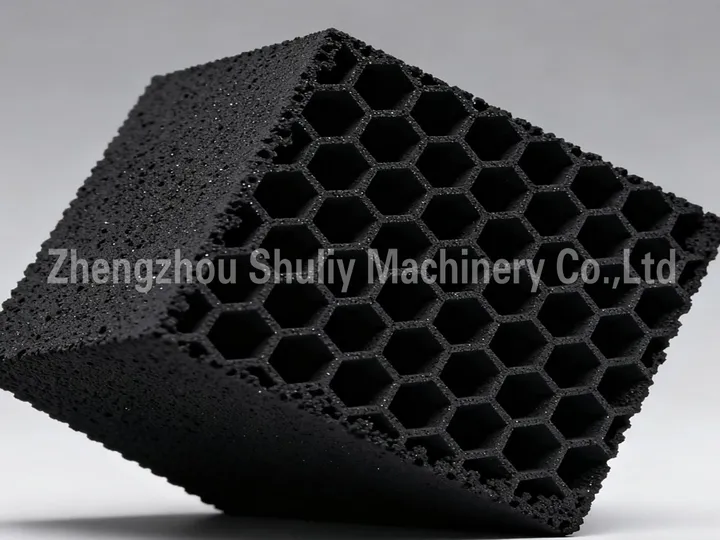
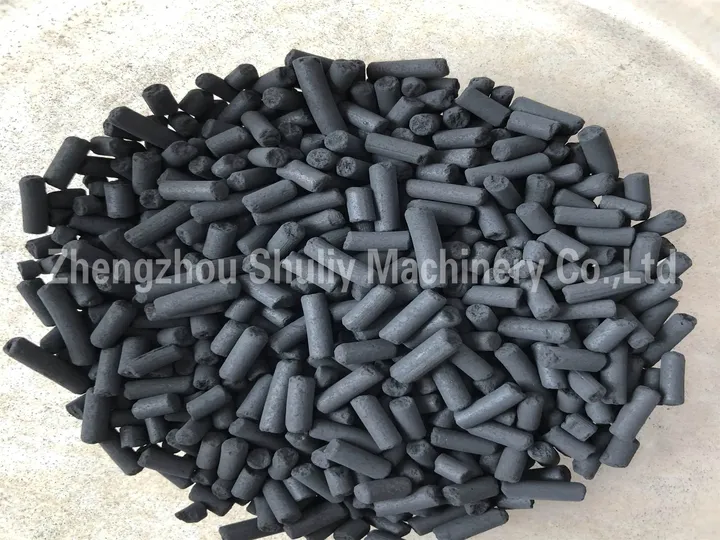
- Water Treatment: Municipal drinking water, wastewater purification, aquarium filtration, swimming pool treatment.
- Air Purification: Industrial exhaust gas treatment, indoor air filters, respirator cartridges, automotive cabin filters.
- Industrial Processing: Gold recovery, chemical purification, solvent recovery, catalyst support, food and beverage decolorization.
- Medical and Pharmaceutical: Drug purification, poison treatment, medical device sterilization.
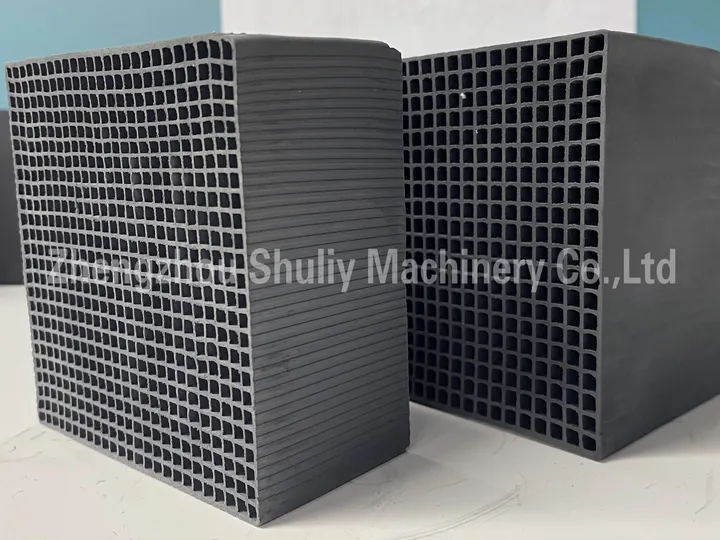
Quality Standards and Testing
Premium activated carbon production equipment must produce material meeting international standards.
- Iodine Number: Measures surface area (800-1,200 mg/g for quality activated carbon).
- Methylene Blue Adsorption: Indicates mesopore volume for liquid phase applications.
- Hardness: Resistance to breakage during handling (95%+ for coconut shell carbon).
- Ash Content: Inorganic residue (below 5% for premium grades).
- Moisture: Final product moisture below 5%.
Our production lines include sampling ports for quality control testing throughout the process.
| Target Product | Temperature | Rotation Speed | Steam Rate | Yield |
|---|---|---|---|---|
| Low iodine value (<1100 mg/g) | ≤950°C | Normal | Standard | High |
| Medium iodine value (900–950 mg/g) | 900–950°C | Increased | Standard | Medium |
| High iodine value (1400–1500 mg/g) | ~1050°C | Reduced | High | Lower |
| High methylene blue value | Lower temperature | Standard | Higher steam | Medium |
How to Choose the Right Activated Carbon Making Machine?
Selecting appropriate activated carbon manufacturing system capacity requires careful analysis.
- Raw Material Supply: Confirm daily availability and consistency of feedstock. Seasonal variations affect production planning.
- Target Market: Drinking water carbon requires different specifications than industrial decolorization carbon.
- Production Scale: Match machine capacity to realistic sales volumes. Oversized equipment wastes capital.
- Energy Costs: Consider local electricity and fuel prices. Gas recycling features reduce operating expenses.
- Quality Requirements: High-value applications need precise temperature control and consistent activation.
- Budget Constraints: Balance initial investment against long-term operating costs and revenue potential.
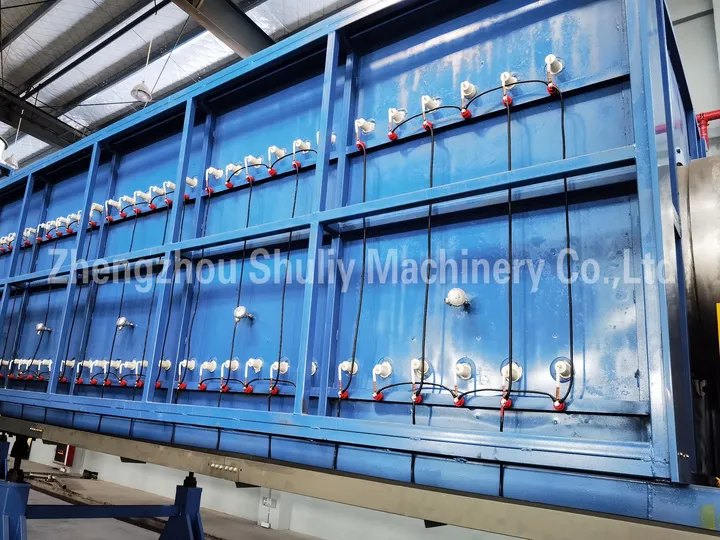
Why Choose Shuliy for Activated Carbon Equipment?
Proven Thermal Engineering: 20+ years of carbonization and activation furnace manufacturing.
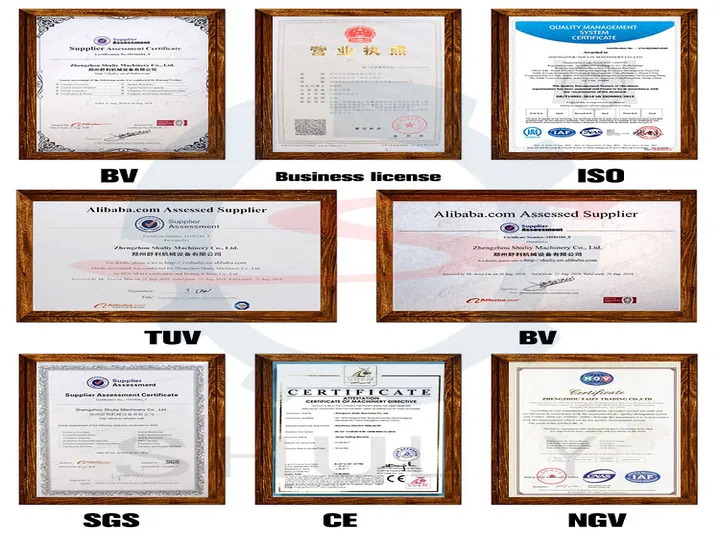
International Certifications: ISO 9001, CE marking, and compliance with environmental standards.
Custom Configuration: We design the activated carbon making machine based on your specific raw material, capacity, and quality requirements.
Comprehensive Support:
- 1-year full equipment warranty
- Lifetime technical support
- Multilingual service team
- Spare parts inventory for immediate shipment
Frequently Asked Questions
What is the difference between carbonization and activation?
Carbonization removes volatile compounds at 400-600°C. Activation develops pore structure at 800-1,000°C using steam or gases.
How long does activated carbon production take?
Total process time is 2-4 hours depending on raw material and target specifications. Continuous systems maintain steady throughput.
What is the yield from coconut shells?
Coconut shells yield 25-30% activated carbon by weight. One ton of shells produces 250-300 kg of finished activated carbon.
Can the machine produce different grades of activated carbon?
Yes. Adjusting activation time and temperature produces different pore structures for liquid or gas phase applications.
Is chemical activation possible with this equipment?
Our standard lines use physical steam activation. Chemical activation with phosphoric acid or zinc chloride requires special corrosion-resistant construction.
What utilities are required?
The system needs electricity, water for cooling and steam, and initial fuel for startup. Gas recycling reduces external fuel demand.
How much space is required for a production line?
A 300 kg/hour line needs approximately 200 square meters. A 2,000 kg/hour line requires 800-1,000 square meters including raw material storage.
Get Your Activated Carbon Making Machine Quote Today
Transform coconut shells, wood waste, or coal into high-value activated carbon with Shuliy’s activated carbon production equipment. Our complete production lines deliver the capacity, quality control, and efficiency needed for competitive activated carbon manufacturing.
Contact our engineering team today for raw material testing, capacity planning, and customized system design based on your specific production goals.
Click the contact window on the right to get in touch with us. We will provide you with a quotation within 24 hours.